
Source 1 - Image
Source 1 - Image
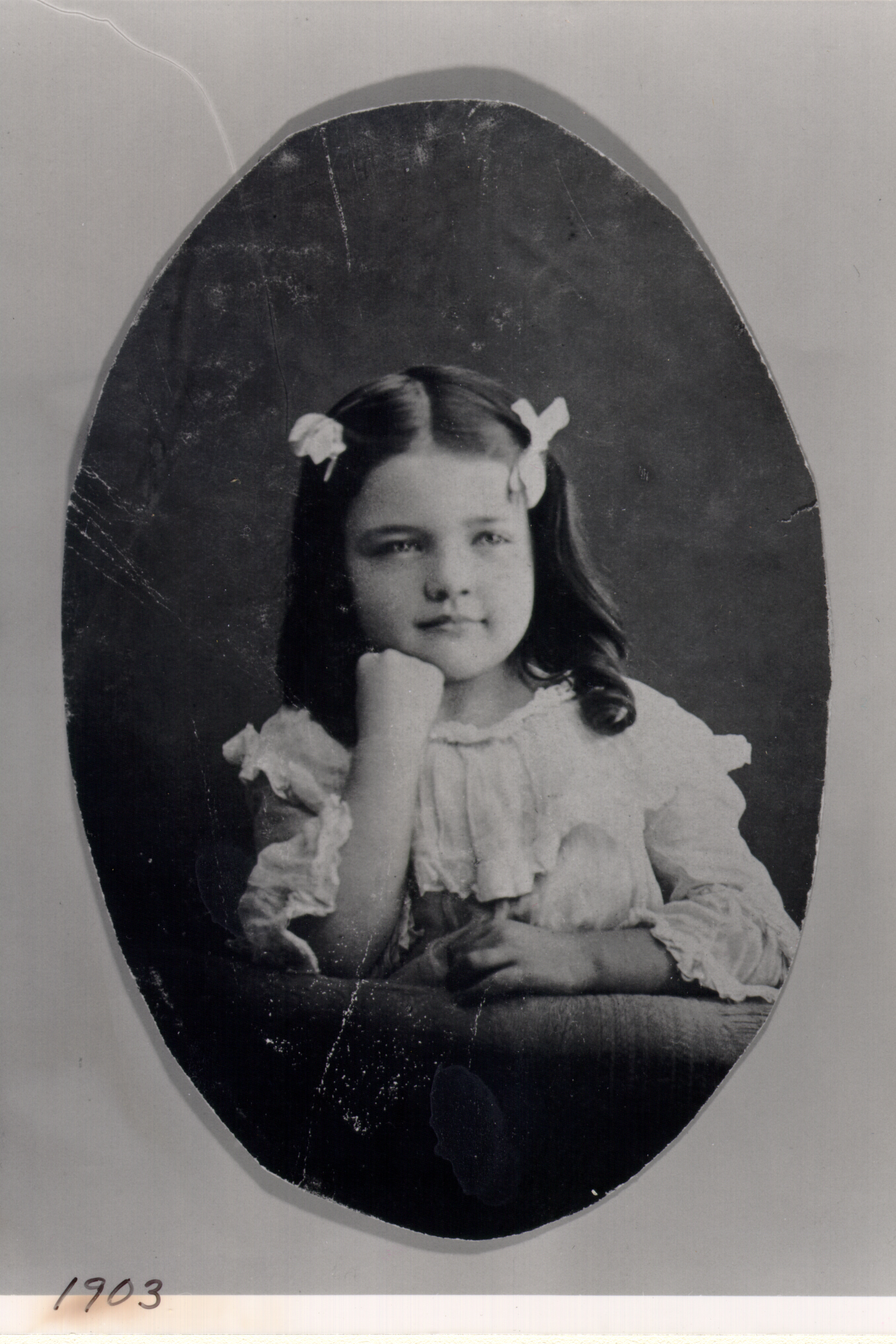
Photograph of Margaret Chase as a Young Girl
1903
Margaret Chase Smith Library, P1769
This photograph shows Margaret Chase at age six in 1903. She was born on December 14, 1897, and was the oldest of six children. Her parents were George Emery Chase and Carrie Murray Chase.
Margaret’s father, George, was a barber. Her mother, Carrie, worked in a store, a shoe factory, and as a waitress. Margaret remembered how her parents always kept the family together, even during hard times. They all lived with her grandfather, John Chase, on North Avenue in Skowhegan, Maine.
Margaret went to local schools in Skowhegan, where she discovered she loved math, and was a member and captain of the girls’ basketball team. In 1912, she went on her senior class trip to Washington, DC. Margaret wanted to go to college to become a physical education (gym) teacher, but her family could not afford to send her.
As a girl and a young woman, Margaret worked many jobs, including in a five-and-ten-cent store, did tax work in the town selectmen’s office, taught briefly in a one-room school, worked as a telephone operator, and on the local newspaper. She was one of the founders and charter members of the Skowhegan Business and Professional Women’s Club. In 1930, while she was business manager of a major textile mill in Skowhegan, Margaret married Clyde H. Smith, a prominent local and state politician.
Source 2 - Document
Source 2 - Document
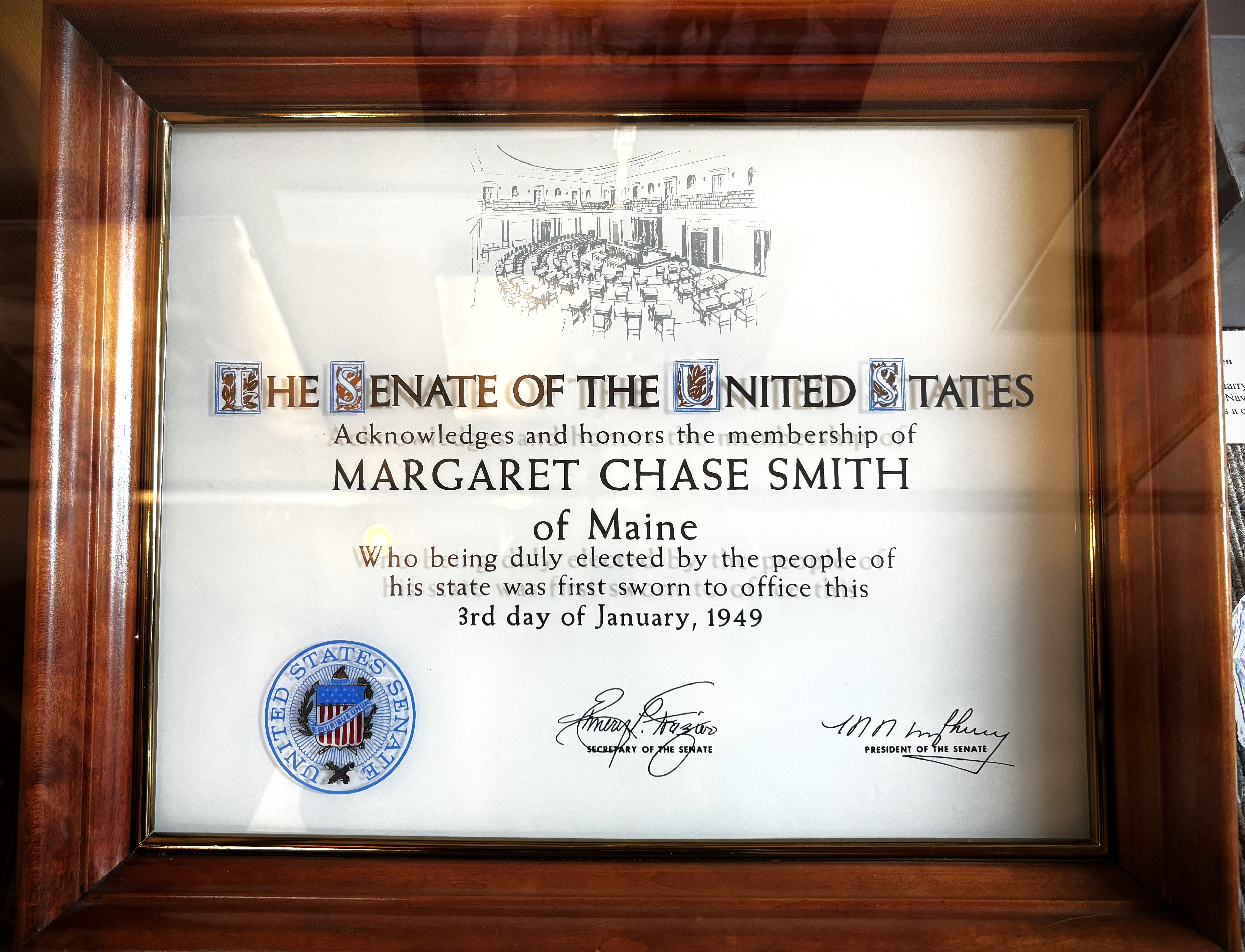
Margaret Chase Smith's Senate Certificate
January 3, 1949
Margaret Chase Smith Library
Margaret Chase Smith’s husband, Clyde Smith was a respected political leader in central Maine. He was elected to the United States House of Representatives from Maine’s Second Congressional District in 1936. Margaret worked with him as his office manager and helped run his campaigns until his early death in 1940.
After her husband died, Margaret Chase Smith took his place in Congress. She was re-elected three times in 1942, 1944, and 1946In 1948, she decided to run for the newly vacant U.S Senate seat and won a hard-fought Republican primary with a low budget grassroots campaign based on local needs and issues. She easily won the general election in September 1948. Margaret became the first woman to serve in both the House and the Senate.
Senator Margaret Chase Smith of Maine was sworn into office on January 3rd, 1949. Her official Senate Certificate called her “his” instead of “her.” Just one way that the U.S. Congress failed to accommodate women legislators, treating them as outsiders. Smith took it all in stride. Certainly, this was not the first time, or the last time, that people were ill-prepared for Margaret.
Source 3 - Document
Source 3 - Document
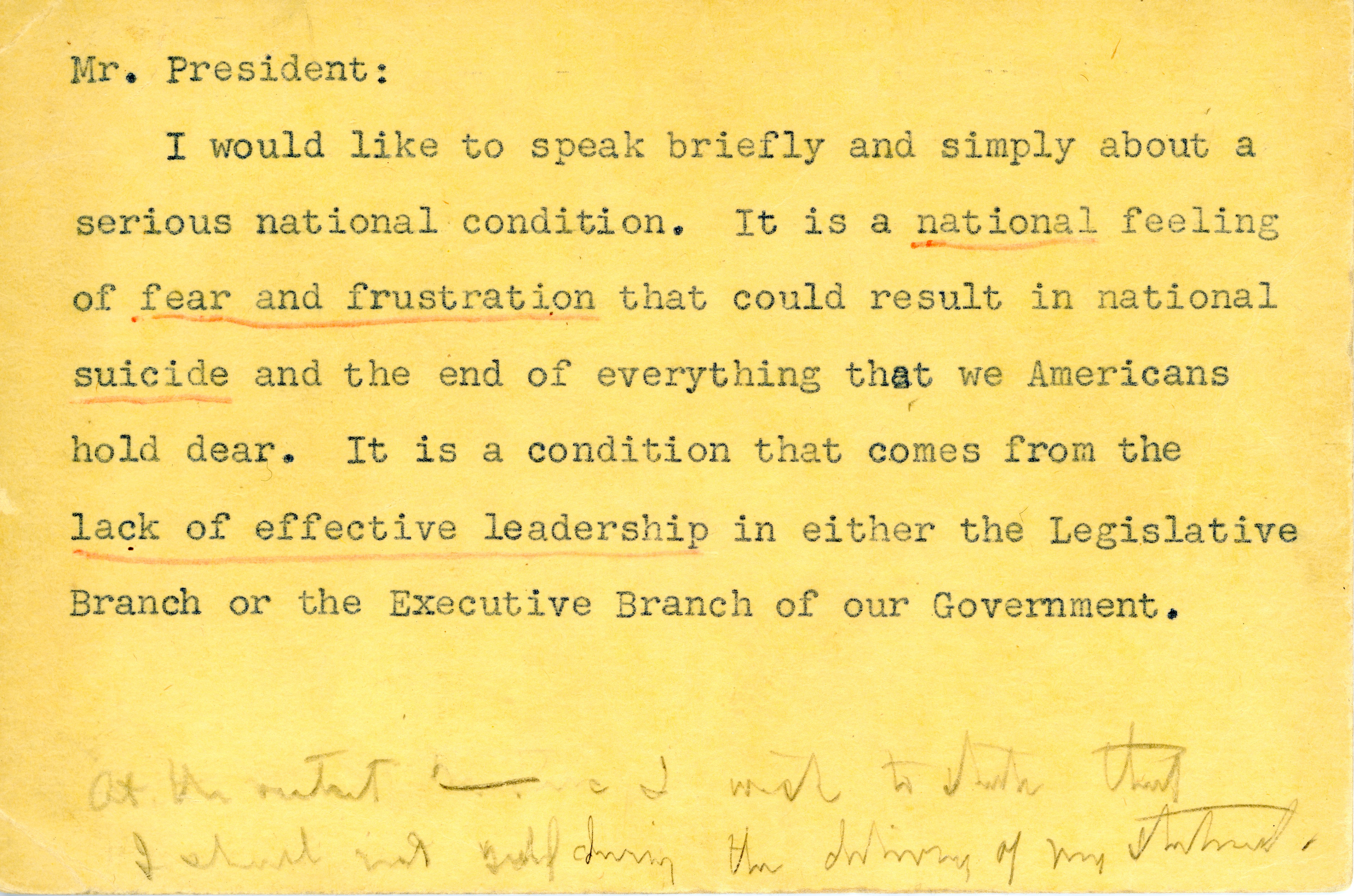
Senator Smith's Declaration of Conscience Notecard
1950
Margaret Chase Smith Library
Margaret Chase Smith used small notecards to draft and organize her speeches. She wrote short notes and underlined important words to help her remember what to say.
On June 1, 1950, Margaret gave a speech in the Senate called the “Declaration of Conscience.” There is no recording of the speech, so the best record we have of it are her notecards, which show her last-minute edits and points of emphasis.
In her speech, she criticized the country’s leaders. She spoke out against the actions of the House Un-American Activities Committee, a group led by Wisconsin Senator Joseph McCarthy. McCarthy and the committee were accusing Americans of having communist ties, often without supporting evidence.
Margaret thought that the House Un-American Activities Committee was destroying the lives of good Americans. Americans who were upholding American ideals – the right to criticize; the right to hold unpopular beliefs; the right to protest; and the right of independent thought.
By opposing McCarthy, Margaret showed the nation her courage and devotion to justice. She said:
“If I am to be remembered in history, it will not be because of legislative accomplishments, but for an act I took as a legislator in the U.S. Senate when on June 1, 1950, I spoke . . .in condemnation of McCarthyism when the junior Senator from Wisconsin had the Senate paralyzed with fear that he would purge any Senator who disagreed with him. That speech is known as the ‘Declaration of Conscience.”
At first, her speech was not well received, but it did give her national attention and remains one of her most well-known contributions to American history.
Source 4 - Video
Source 4 - Video
Senator Margaret Chase Smith and Eleanor Roosevelt Debate on "Face the Nation"
November 4, 1956
Margaret Chase Smith Library
1956 brought another first for Margaret when she debated Eleanor Roosevelt on national television in the first televised presidential debate. Democratic candidate Adlai Stevenson was challenging incumbent Republican president Dwight Eisenhower – but those two men did not appear in the debate, instead former First Lady Eleanor Roosevelt stood in for Stevenson and Senator Margaret Chase Smith stood in for Eisenhower.
The debate took place on Face the Nation, a new program on CBS and it was the first time a woman appeared on that program. The debate took place just two days before the election, and the main topic of the debate was foreign policy. Early in the debate, questions focus on the recent invasion of Egypt by Israel, Britain, and France in late October to maintain control of the Suez Canal.
Margaret carefully prepared for her appearance on Face the Nation and practiced delivering concise sound bites. She negotiated for a two-minute closing statement, which CBS reluctantly allowed her, but did not offer to Roosevelt.
Although there was no clear winner of the debate, it was clear that Margaret understood how to use television to her advantage. At the end of the debate, Roosevelt refused to shake hands with Margaret.
Four years later, Senator Smith drew on this experience when she debated Lucia Cormier in one of the first televised debates between candidates for U.S. Senate. This race in Maine was historic, marking the first time in American history that two women ran against each other for a Senate seat.
Source 5 - Artifact
Source 5 - Artifact
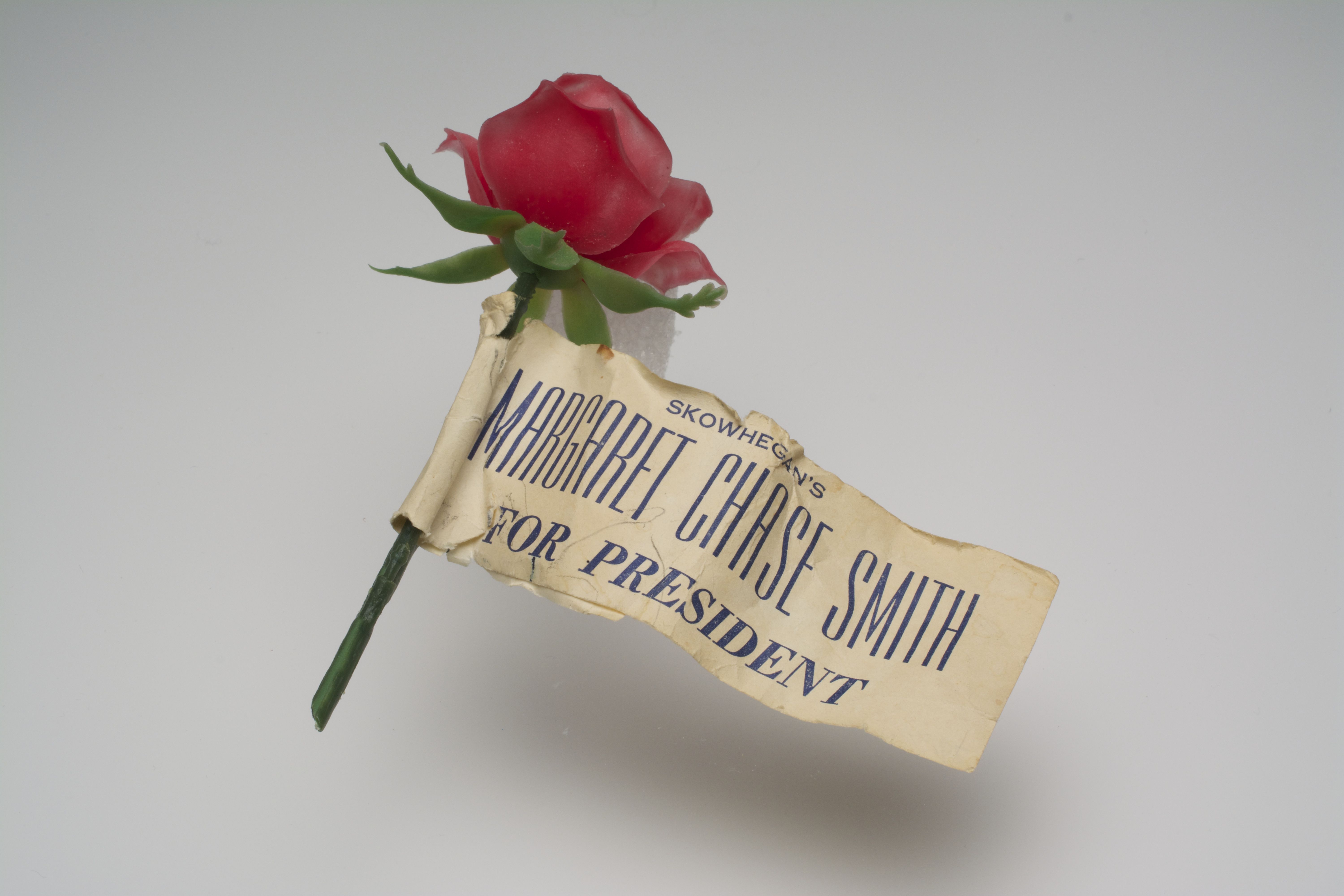
Margaret Chase Smith Campaign Pin
1964
Maine State Museum, 79.34.1
On January 27, 1964, Margaret Chase Smith spoke to the Women’s National Press Club. She joked that she didn’t have enough money or a big team to help her run for the Republican presidential nomination, and that she probably wouldn’t win. She also said that people told her women shouldn’t try to become president. At the end of her speech, Smith surprised everyone by saying, “So because of these very impelling reasons against my running . . . I have decided that I shall.”
Smith wanted to run for president because she had twenty-four years of experience in Congress. She didn’t ask people for money to help her campaign. She also wouldn’t leave her job in the Senate to campaign, because she never wanted to miss an important vote. Smith used her own money and had volunteers who worked for free. She didn’t buy any TV or radio ads.
The Republican Party held its convention in July 1964. On July 15, Margaret Chase Smith became the first woman ever chosen by a major political party to run for president. When it was time to vote, Senator Smith received support from 27 delegates, compared to 883 for Senator Goldwater. Smith came in second. Later that year, in November, Senator Goldwater lost the presidential election to President Lyndon Johnson.
Margaret Chase Smith was famous for wearing a red rose pinned to her suit. She waged a long campaign to have the rose declared the official flower of the United States. The rose stood for the idea that a politician could be polite and yet powerful. During her campaign for president, pins with a plastic rose or an image of a rose were given away to supporters.
Source 6 - Image
Source 6 - Image
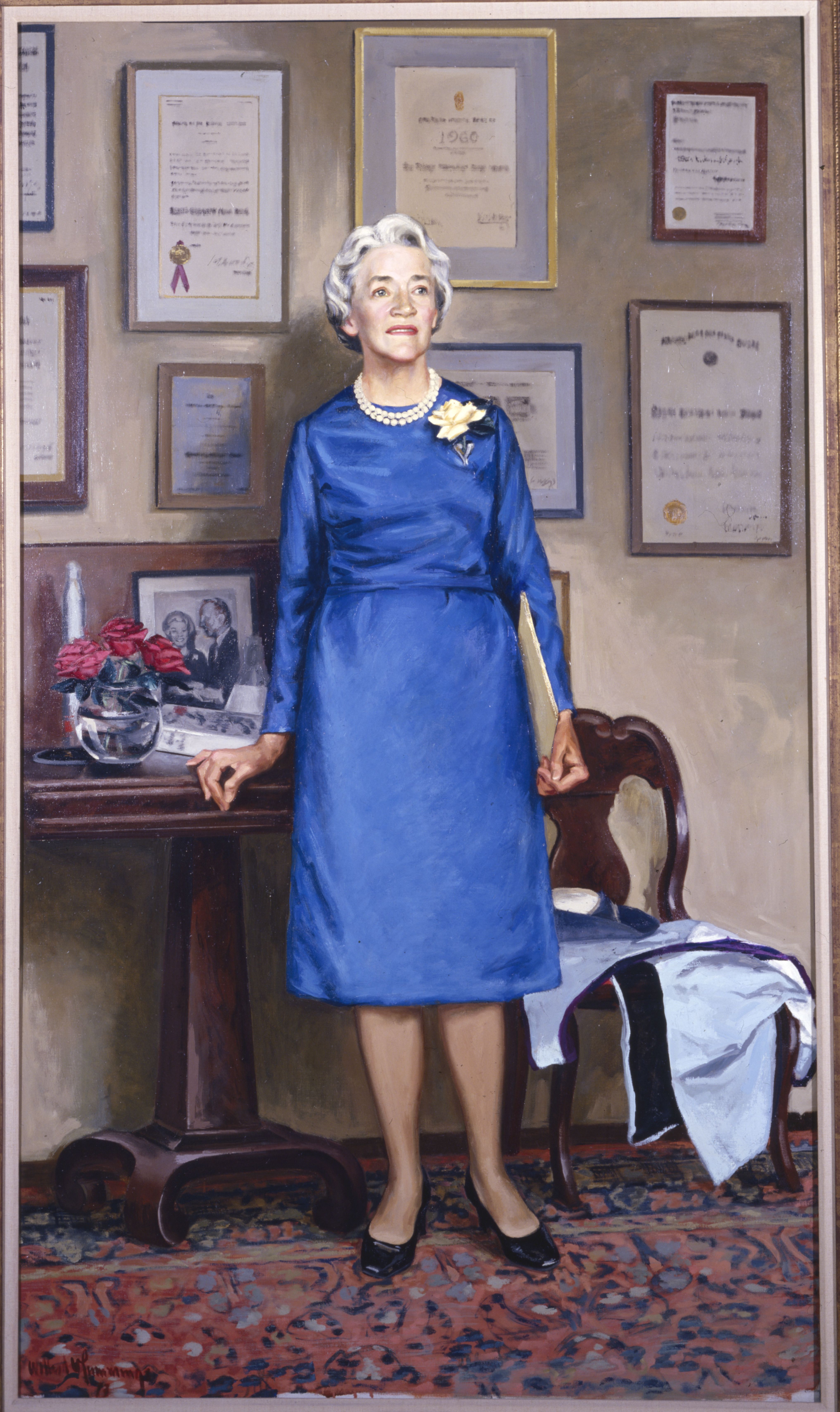
Portrait of Margaret Chase Smith
Painted by Willard Cummings
1974
Maine State Museum, 74.20.1
Senator Margaret Chase Smith retired in 1973 after serving 32 years in Congress. She helped to break down barriers to women serving in political office. She established the Margaret Chase Smith Library next to her house in Skowhegan, Maine. The library has her papers, pictures, and awards from her long career in Congress. It opened in 1982, and people can visit to learn about her life and work.
After she retired, Smith received recognition across the country and was awarded many honors. In 1989, President George H. W. Bush awarded her the Medal of Freedom, the highest honor for a citizen. Smith continued to serve as an important role model until her death at age 97. Margaret Chase Smith died on Memorial Day, May 29, 1995.
This portrait, painted by William Cumming, hangs in the Maine Capitol Building’s Hall of Flags in Augusta, Maine, and helps to preserve her legacy for generations of Mainers to come.